
When to replace brake discs — and how to tell
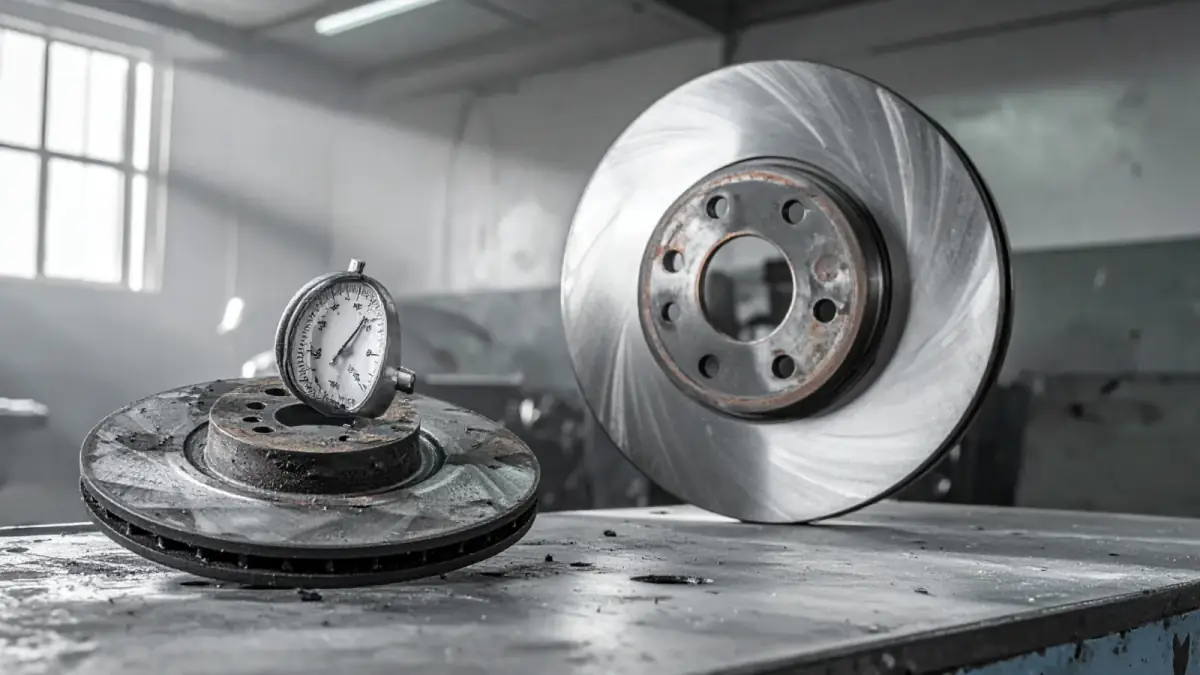
Every disc carries a minimum thickness stamped into the hub face or the edge — usually written as MIN TH. That figure is the legal and mechanical floor, not a target. A disc measuring at or near it has no material left to absorb heat, and it will warp on the first hard stop.
The three checks worth doing
- Lipping. Run a fingernail across the outer edge. A lip you can catch means the friction face has worn down around it.
- Blueing. A blue or straw tint means the disc has been overheated. The metallurgy has changed and it will not recover.
- Judder through the pedal. Usually thickness variation rather than a "warped" disc — measurable with a micrometer at eight points around the face.
Always in pairs
Replace discs across an axle, never one side. A new disc on one corner and a worn one on the other pulls under braking, and the pad bedding differs between the two. The same applies to pads.
If you are replacing discs, replace the pads with them — old friction material carries the wear pattern of the old disc and will never bed evenly against a new face.
Written for Redline Motor Factors — a demonstration store. See the AgenticEcom Suite.